
How Art, Movement and Play Support Learning in Reggio Emilia Preschools
- Education
James Kerr
- 0
- 8 minutes read
Key Highlights
- Art gives children different ways to explore and communicate their ideas.
- Movement allows young learners to understand concepts through physical experience.
- Purposeful play creates opportunities for investigation and problem-solving.
- Teachers can extend learning by observing children’s interests and questions.
Empowering Early Development Through Creative Exploration
Young children do not rely solely on words to understand or communicate their ideas. They draw, build, move, experiment and play as they make sense of experiences around them. Many preschools in Singapore therefore incorporate creative and hands-on experiences into early childhood learning.
Such experiences hold particular significance within the Reggio Emilia approach in Singapore, where children are viewed as capable learners who can express their thinking in many different ways. Art, movement and play are not simply breaks between lessons. Each can become a meaningful avenue through which children investigate questions, communicate discoveries and develop their understanding.
Art Gives Children’s Ideas a Visible Form
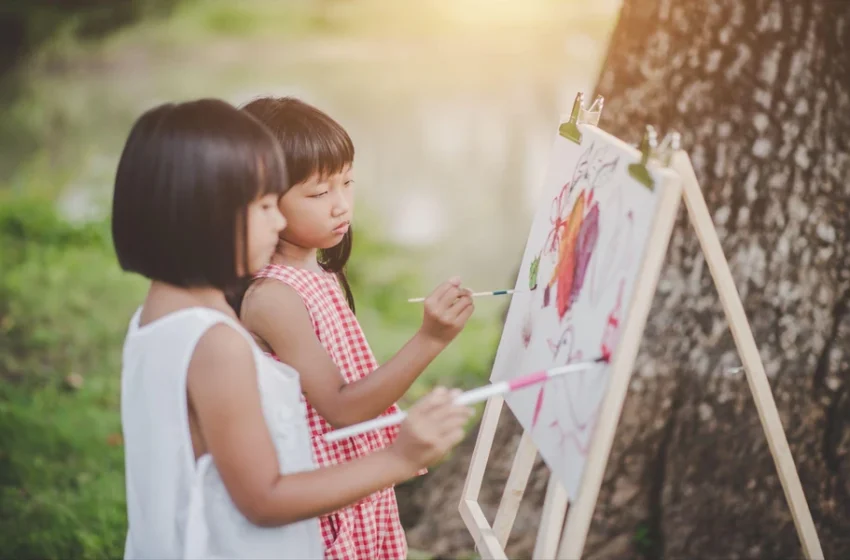
Painting, drawing, sculpting, and building give young learners a powerful outlet to express thoughts, emotions, and theories they might not yet have the words to explain. A child’s creative process reveals how they observe the world, test new ideas, and make sense of their surroundings.
- Expressing the Unspoken: Translates complex internal thoughts and observations into visible forms long before a child develops full verbal vocabulary.
- Focusing on Process Over Product: Shifts attention away from neat, finished crafts to value the decisions, experimentation, and problem-solving happening during creation.
- Deepening Observation: Encourages children to revisit ideas-like redrawing a leaf after closer inspection-to discover overlooked details and refine their understanding.
- Revealing Thinking Patterns: Highlights how material choices, recurring shapes, and conversations during art-making provide windows into a child’s unique perspective.
Educators who implement the Reggio Emilia approach in Singapore view art as one of the many “languages” children use to communicate and learn. Valuing the creative process empowers kids to explore their curiosity, experiment freely, and take ownership of their learning journey.
Movement Turns Abstract Ideas Into Physical Experiences
Children naturally use their bodies while exploring their surroundings at preschools in Singapore. Running, balancing, arranging objects and changing position can help them investigate distance, space, speed and relationships through direct experience.
Learning environments can make purposeful movement part of exploration rather than expecting children to remain seated for extended periods. A child might recreate the movement of an animal, measure a space using footsteps or work with classmates to construct something large enough to enter.
Physical activity can also encourage cooperation and awareness. Moving alongside others requires children to negotiate space, respond to instructions and adjust their actions. Such experiences connect physical development with communication, observation and problem-solving in a natural way.
Play Creates Space for Questions and Investigation
A block tower that keeps collapsing can become an investigation into balance. Pretend shops can introduce counting and communication, while outdoor play may lead children to examine insects, leaves, shadows or changing weather.
Teachers inspired by the Reggio Emilia approach in Singapore can observe these moments and identify opportunities to extend children’s thinking. Instead of immediately supplying an answer, an educator might introduce another material, ask a thoughtful question or encourage children to test their own explanation.
Play therefore becomes more than entertainment. Children encounter problems that matter within the activity they have chosen, giving them a genuine reason to experiment. Their discoveries can then lead naturally towards further questions and new directions for learning.
Different Forms of Expression Can Work Together
Creative learning rarely fits neatly into a single, isolated activity. When children are inspired by a story or concept, they naturally explore it across multiple mediums-drawing characters, acting out scenes, building settings, and talking through alternative endings with their peers.
| Multi-Modal Learning Approach | How It Deepens Early Understanding |
| Story-to-Art Connections | Translates narrative themes into visual drawings and sculptures, helping children process plot and character motivations. |
| Imaginative Role-Play | Encourages kids to act out scenarios, building empathy and oral communication skills through dramatic play. |
| Hands-On Construction | Uses blocks and loose parts to build physical representations of abstract ideas, strengthening spatial awareness. |
| Teacher Documentation | Captures artwork and discussions so teachers can revisit them with children, encouraging self-reflection and growth tracking. |
Many preschools in Singapore blend art, movement, conversation, and play to help children explore concepts from multiple angles. Continuously returning to an idea through different expressive tools deepens comprehension, boosts engagement, and makes early learning memorable.
Cultivating Lifelong Curiosity Through Holistic Expression
Art, movement and play can become powerful forms of learning when children have time to investigate ideas rather than simply follow predetermined outcomes. By drawing, building, moving and imagining, young learners can communicate their thinking while developing creativity, physical awareness and problem-solving abilities. An environment that values these different forms of expression allows learning to grow from children’s genuine observations and interests.
Contact EtonHouse to discover an early learning environment where children’s ideas, creativity and curiosity can shape meaningful educational experiences.
F.A.Q.
- How does art help young children express their complex ideas?
It lets kids share their thoughts when they do not have the vocabulary for them yet. - Why is physical movement important in a preschool setting?
It helps children explore abstract concepts through direct and physical experiences. - Is playtime considered just a form of entertainment?
No, it is a way for children to solve problems and investigate their unique ideas. - Can art and play work together to boost learning outcomes?
Yes, combining different expressions deepens their overall understanding. - How do teachers help to extend children’s learning?
Teachers observe interests and ask open questions to extend their active learning.
