
How Should Students Approach Difficult A-Math Questions?
- Mathematics
Mark Vargas
- 0
- 7 minutes read
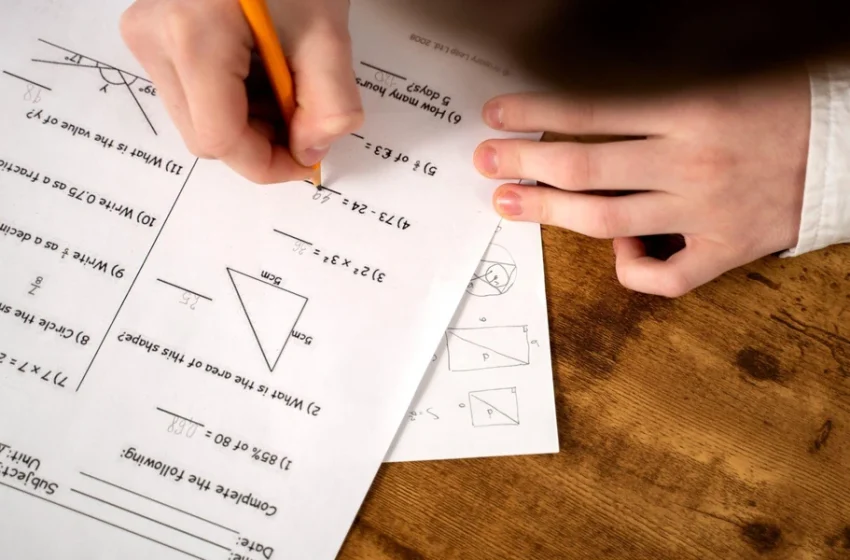
Additional Mathematics introduces students to topics that require increasingly abstract and multi-step reasoning. A question may involve several stages of algebraic manipulation or require students to decide which mathematical concept is relevant before they can begin solving it.
Difficult questions therefore require more than memorising formulae. Students need a systematic way to interpret the problem, select an appropriate method, work through each stage, and check the result.
Why Do Students Find Some A-Math Questions Difficult?
A-Math topics build on earlier mathematical knowledge. Weaknesses in algebra, equations, graphs, or basic manipulation can consequently make more advanced problems harder to complete.
Difficulty can also arise when questions combine concepts or present familiar mathematics in an unfamiliar format. Instead of being told which method to use, students may need to recognise the underlying concept themselves.
Common challenges include:
- identifying which topic or formula applies;
- translating written information into mathematical expressions;
- completing several connected steps accurately;
- manipulating algebraic expressions;
- keeping track of negative signs, brackets, and substitutions; and
- recognising connections between different topics.
Understanding the source of difficulty helps students decide what to address. The next step is to turn a complex question into a series of manageable tasks.
How Should Students Break Down a Difficult A-Math Question?
Students can begin by reading the entire question before performing calculations. They should identify what information is provided, what must be found, and any conditions that affect the solution.
A structured approach can make this process clearer:
| Step | What to do |
| Identify the goal | Determine exactly what the question asks for |
| Extract information | Mark relevant values, equations and conditions |
| Identify the topic | Consider which mathematical concepts are involved |
| Select a method | Choose an appropriate formula or technique |
| Solve in stages | Complete one logical step at a time |
| Review | Check the working and final answer |
Writing down intermediate steps is particularly useful for multi-stage questions. It allows students to see how one result leads to another and makes errors easier to locate.
Breaking questions down does not guarantee an immediate solution, but it provides a clear starting point. If the appropriate method remains unclear, students can then use several strategies to move forward.
What Should Students Do When They Get Stuck on an A-Math Question?
Repeatedly attempting the same calculation may not resolve a conceptual problem. Students can instead reconsider how they have interpreted the question.
Useful actions include:
- re-reading the question and identifying important mathematical terms;
- listing the known and unknown quantities;
- drawing a diagram or sketch where relevant;
- writing down related formulae or relationships;
- checking whether an earlier step contains an error;
- considering whether a simpler part of the problem can be solved first; and
- moving to another question during a timed paper and returning later.
After practice sessions, students should review questions they could not complete rather than simply copy the correct solution. Understanding where their reasoning stopped can reveal whether the issue involved knowledge, method selection, algebra, or calculation.
These strategies help students restart their reasoning. Once a solution has been reached, checking the working is the next important stage.
How Can Students Check Their A-Math Working and Answers?
Checking should involve more than repeating the same calculation. Students can examine individual stages to determine whether the mathematics remains consistent.
They should check:
- signs, brackets and algebraic manipulation;
- substitutions and copied values;
- arithmetic calculations;
- formulae and mathematical notation;
- whether all required parts have been answered; and
- whether the final result is reasonable within the context of the question.
Where possible, students can substitute an answer back into the original equation or use another valid method to verify it. Clear working also makes it easier to identify exactly where an error occurred.
Consistent checking can reduce avoidable mistakes, but repeated difficulty across particular topics may indicate a broader learning gap that requires additional support.
When Might Students Need Additional Support With Difficult A-Math Questions?
Occasional difficulty is a normal part of learning challenging mathematical material. Additional support may be useful when students repeatedly struggle with the same concepts, cannot identify suitable methods, or have foundational gaps that affect newer topics.
Support can come from school teachers, classmates, textbooks, worked examples, revision resources, or structured programmes. Students considering additional maths tuition in Singapore can assess whether the teaching approach addresses their specific conceptual or problem-solving difficulties rather than focusing only on completing more questions.
Similarly, A-math tuition in Singapore may provide additional opportunities for guided practice and feedback outside regular lessons. Regardless of the source of support, students still need to practise independently and review their mistakes to strengthen their problem-solving skills.
FAQs
What should I do first when facing a difficult A-Math question?
Read the full question and identify what is given and what needs to be found. Then determine which mathematical topic or relationship is likely to apply before starting calculations.
Should I skip an A-Math question if I cannot solve it?
During a timed assessment, moving temporarily to another question can help students manage their available time. They can return to the difficult question after completing other sections.
How can I reduce careless mistakes in A-Math?
Write calculations clearly and check signs, brackets, substitutions, arithmetic, and the final answer. Reviewing recurring mistakes can also help identify areas that require greater attention.
Is memorising formulae enough for A-Math?
Knowing relevant formulae is important, but students must also understand when and how to apply them. Many questions require students to select and combine methods based on the information provided.
How can students improve at difficult A-Math questions?
Regular targeted practice, error analysis, review of foundational concepts, and feedback can help students develop stronger problem-solving skills. Practice is most useful when students understand why a method works rather than simply reproducing a model answer.
Visit Sirius Mathematics to build a more structured approach to challenging A-Math problems.
